



 Kennzahlen

 Bilfinger Berger Magazine 2/2009




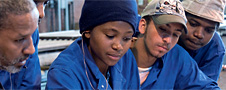
ENERGY IS IN SHORT SUPPLY IN SOUTH AFRICA AND THE COUNTRY NEEDS NEW POWER PLANTS. BILFINGER BERGER POWER SERVICES IS EXPANDING ITS CAPACITY AND BRINGING BOTH JOBS AND THE LATEST TECHNOLOGY TO PRETORIA.
Gladness Mampa is 22. Her hair is hidden beneath a red cap and the blue coverall hangs loosely on her slender arms. Working as an apprentice with Bilfinger Berger Power Services, with fixed concentration she welds narrow steel tubes into the complex patterns utility giant Eskom has ordered for its new Medupi and Kusile coal-fired power stations in the north east of the country.
Gladness Mampa recalls two occasions when fortune smiled on her. The first was when her father paid for her alone among his seven children to go to grammar school. The second was when she was serving drinks at a trade fair and learned by chance that Bilfinger Berger Power Services was training young people in Pretoria. A rarity in South Africa, where there is no obligation for companies to offer apprenticeships. Gladness phoned immediately, and soon after was hired as a trainee. For the past year she has been learning to use grinders, welding guns and even the big traveling cranes that can lift twelve-ton loads. “In two years I will be a boilermaker and earn more than my father,” she says and smiles shyly. Her father is very proud of her, she adds.
Video: HOW STEEL PIPES GET INTO SHAPE WITH INDUCTIVE BENDING
CUTTING, WELDING, BENDING
Next door to Gladness Mampa’s boiler production plant, a huge new facility is taking shape: A copy of a plant in Dortmund where Bilfinger Berger Power Services produces high-pressure pipes for power stations. Power Services is the European market leader. Soon, the company will be cutting, welding and bending pipes not just in Germany’s Ruhrgebiet but also in South Africa. These pipes are huge, up to 85 centimeters in diameter with wall thicknesses of up to ten centimeters. They must withstand temperatures up to 600 degrees Celsius as steam gushes from boilers to turbines. The pressure inside the pipes can reach 280 bar, a hundred times as much as a fully inflated car tire.
To coax this highly stable material into shape, the power station builders in Pretoria have ordered a bending machine similar to the one in Dortmund. This expensive and highly specialized piece of equipment is due to arrive in South Africa in the new year. Bilfinger Berger is investing a total of €11 million in the new plant, including the training of skilled workers. Why such expenditure when the technology is already available in Germany?
NO ELECTRICITY, NO GROWTH
“There is a boom ahead for South Africa’s energy suppliers,” says Salvador von Neuberg, 64, manager of Bilfinger Berger Power Services in Pretoria. “Our contract for the new Medupi and Kusile coal-fired stations alone is worth €85 million.” With 36 years of experience in the power station business in South Africa, von Neuberg is confident there are more orders to come. “There have been no new facilities built here for almost 20 years.” Despite the fact that between 1985 and 2007 electricity consumption nearly doubled. The economy flourished and the platinum, gold and chromium mines grew steadily. Such mines require vast amounts of electricity, with the result that energy supply bottlenecks have been occurring for some years now. The shortage of electricity is restricting economic growth, as whole townships are left in darkness from time to time.
An end is now in sight. The South African government is investing in the energy sector and attracting highly specialized technology pro – viders to the country—Bilfinger Berger’s highpressure piping experts among them. When contracts are awarded, however, preference is given to companies that manufacture in South Africa rather than importing components. “If we hadn’t offered to build the new factory and create 200 new jobs in Pretoria, we wouldn’t have won the order,” says von Neuberg.
RETIREMENT MUST WAIT
If the complex bending technology is to be made to work in Pretoria, not only modern machinery but also the accompanying expertise must come to the Cape. So there is plenty of toing and froing of employees between Germany and South Africa.
In Dortmund, Gerd Seidel is getting ready for his trip to Pretoria. At the age of 65, after working for years at Bilfinger Berger Power Services as quality manager and sharing in the development of bending and welding technologies, his pension beckoned. But he put retirement on hold for the chance to get the new facility up and running. His instructions on a wide range of technical processes are even now being translated into English. He will be there in Pretoria when the bending machine is set up. But at the moment Seidel is still in Dortmund, strolling through the plant between steel pipes large enough for children to play hide-and-seek in. He stops in front of a greenpainted steel colossus. “This is the inductive bending machine,” he says, “the heart of the place.”
NO MORE APARTMENT, NO MORE CAR
Peter Godler, 55, uses a crane to hoist a twelvemeter long pipe into the machine the size of a locomotive. Then he fits a narrow copper ring a few centimeters in width around the pipe at the point where the bend must begin. The ring is an induction coil—pass electricity through it and the pipe beneath begins to glow. Moving in ultra-slow motion, the front part of the machine, the “bending arm,” describes the required curve, as the pipe is forced through the copper coil, millimeter by millimeter. It can take up to ten hours to bend one of the huge pieces into shape, Peter Godler explains. He has given up his apartment in Mülheim, sold his car. At the end of the month he will also be off to South Africa with a three-year contract as bending plant foreman in his pocket.
EVERY WELD IS DOCUMENTED
South African employee Liana Svanepoel has come to Dortmund from Pretoria. She will be responsible for quality assurance at the new plant. If a customer takes delivery of a defective pipe, there must be an audit trail to discover whether the material, the workmanship or the conditions in transit were at fault. For this reason, every pipe processed by Power Services is stamped with a number. Each individual weld seam is marked to show who worked on it and when. Hundreds of work stages are precisely documented, and Liana Svanepoel’s task in Pretoria will be to keep track of them all: “Here in Dortmund I am reading myself in, so to speak, but I’m also talking to lots of other people so I can understand how they work here.” Back in Pretoria she will then explain the complex procedures to her own staff.
WHERE ARE THE YOUNG BLACK ELITE?
Liana Svanepoel is white, as are almost all her senior management colleagues at Bilfinger Berger in Pretoria. Many of them are South Africans, but where are the young black elite? “In the course of time more and more management positions will be held by blacks,” Salvador von Neuberg believes. Thanks not least to the Black Economic Empowerment legislation passed by the government headed by Thabo Mbeki in 2004. The law requires that the composition of a company’s workforce must reflect the ethnic composition of the country itself. “That’s not something we can achieve overnight,” says von Neuberg. One of the reasons is that for decades it was predominantly whites who had access to universities and higher education. A qualified black middle class is only now emerging, and engineers in particular are in short supply for the time being.
“Now, however, there is a new, self-confident generation on the rise, and we are training them,” says von Neuberg. The new plant in Pretoria, due to start production in spring 2010, is contributing 40 new apprenticeships to the country’s capital city. For many talented young people these offer a way out of the cycle of poverty in which their parents were trapped.
22-year-old Gladness Mampa has high hopes. “I want to keep on growing and learning,” she explains. “Most of all, after my apprenticeship I would like to study and be promoted to departmental manager.” She is quick to learn, she adds, and strong too. “Then when young girls see me, let them think, I would like to be a lady like that.”
(Text: Sara Mously, Photos: Eric Vazzoler)
Bilfinger Berger Magazine 2/2009


